

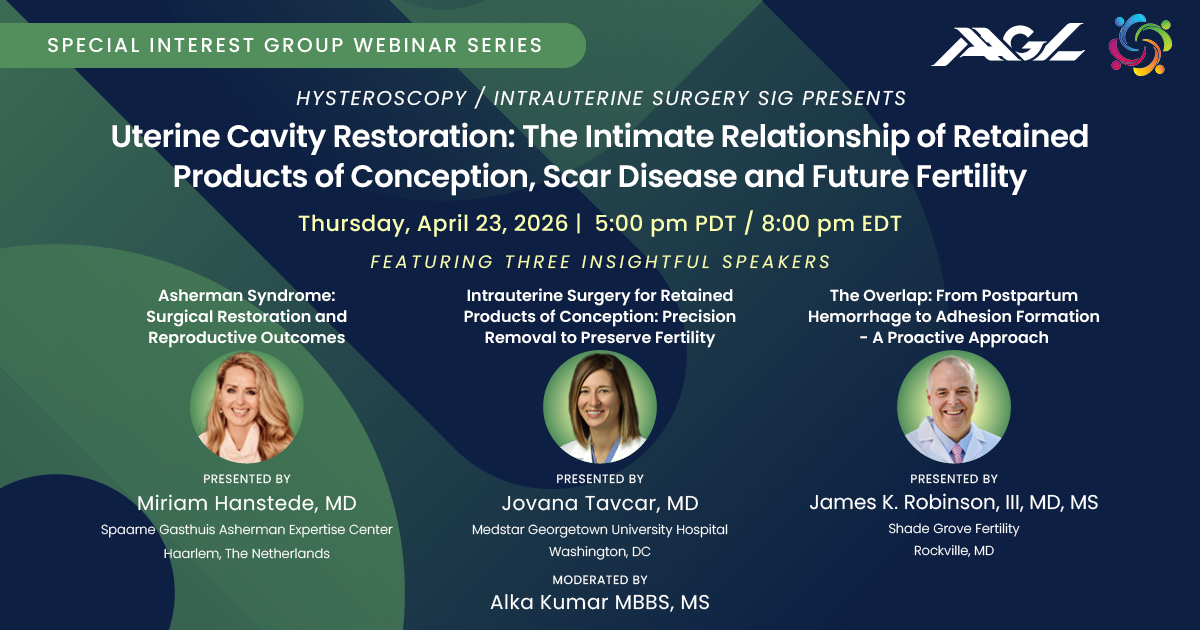
AAGL Hysteroscopy/Intrauterine Surgery SIG Webinar: Uterine Cavity Restoration: The Intimate Relationship of Retained Products of Conception, Scar Disease and Future Fertility
AAGL SIG Webinars Are Now Membership Exclusive:
Starting in 2026, AAGL’s Special Interest Group (SIG) Webinars are exclusive for AAGL Members only. You can register for multiple webinars including webinars that have not yet been scheduled. The system will send you an update once we have a confirmed dates and times.
Please click here to register for this webinar and to review the webinars’ topics and months offered and register.
AAGL Hysteroscopy/Intrauterine Surgery SIG Webinar:
Webinar Topic: Uterine Cavity Restoration: The Intimate Relationship of Retained Products of Conception, Scar Disease and Future Fertility
Presented by:
Miriam Hanstede, MD, Spaarne Gasthuis Asherman Expertise Center, Haarlem, The Netherlands
Topic Title: Asherman Syndrome: Surgical Restoration and Reproductive Outcomes
Jovana, Tavcar, MD, Medstar Georgetown University Hospital, Washington, DC
Topic Title: Intrauterine Surgery for Retained Products of Conception: Precision Removal to Preserve Fertility
James K. Robinson, III, MD, MS, Shady Grove Fertility, Rockville, MD
Topic Title: The Overlap: From Postpartum Hemorrhage to Adhesion Formation – A Proactive Approach
Moderated by:
Alka Kumar MBBS, MS
Webinar Description: This webinar will explore the relationship between retained products of conception (RPOC) and the development of intrauterine adhesions, highlighting their pathophysiologic overlap and clinical implications. Emphasis will be placed on proactive strategies in the postpartum period, particularly in patients with abnormal placental separation, postpartum dilation and curettage, retained placenta, or placenta accreta spectrum disorders. The session will also examine the role of intrauterine surgical techniques in the effective management and resolution of retained products of conception and retained placenta.
Webinar Course Objective(s):
1. Learn about technique and evaluate reproductive outcomes after hysteroscopic adhesiolysis for Asherman syndrome.
2. Apply hysteroscopic techniques for fertility-preserving management of RPOC.
3. Broaden knowledge on the pathophysiologic link between retained products of conception (RPOC) and intrauterine adhesions (IUA).
4. Identify patients at highest risk of adhesion formation after postpartum hemorrhage and suction D&C and consider a proactive postpartum strategy to prevent long-term uterine cavity damage.